Introduction
Every audio interface needs a great microphone, but walking into the pro-audio market can be overwhelming. The most fundamental choice you will make when building your signal chain is selecting between a Dynamic and a Condenser microphone. This decision depends entirely on your specific application, your room’s acoustic environment, and your sound source. Let’s break down the science and look at the best industry-standard gear you can get today.
The Dynamic Microphone: The Indestructible Workhorse
Dynamic microphones are the tanks of the audio world. They are mechanically simple, incredibly rugged, and built to survive. In fact, live sound engineers joke that you can use a classic dynamic microphone to drive nails into a stage, and it will still record flawlessly right after.
From an acoustic standpoint, dynamic microphones can handle extreme Sound Pressure Levels (High SPL) without distorting the signal, and they are significantly less sensitive to ambient room noise. This makes them the absolute standard for live stages, loud guitar amplifiers, snare drums, and untreated home studios.
Top Dynamic Recommendations on Thomann:
- Shure SM58: The legendary live vocal microphone. Indestructible, reliable, and features a built-in pneumatic shock-mount system.
- Shure SM7B: The undisputed king of broadcasting, podcasting, and modern rock/metal vocals. It requires a lot of gain but rejects background noise phenomenally well.
- Sennheiser e906: Perfect for capturing the true grit of electric guitar amplifiers and brass instruments.
The Condenser Microphone: The Detail Master
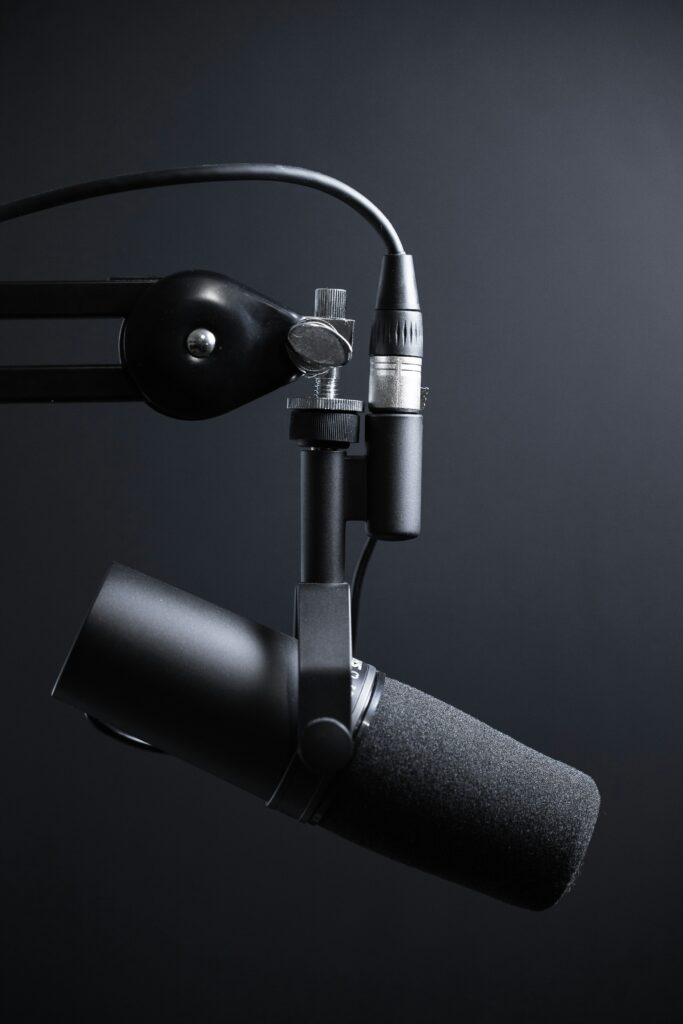
On the other side of the spectrum, we have the condenser microphone. Instead of a heavy moving coil, it uses an ultra-thin, sensitive diaphragm. This engineering allows it to capture a wider frequency response, exceptionally fast transients, and beautiful high-end air and detail. If you want to record the subtle nuances of an acoustic guitar or an intimate vocal performance, a condenser is unmatched.
However, this extreme sensitivity comes with two major requirements:
- Acoustic Treatment: Because it captures everything, an untreated room will result in your microphone recording the hum of your air conditioner, computer fans, or traffic outside.
- Phantom Power (+48V): Condenser electronics are active. They require external power, which is supplied directly from your audio interface via an XLR cable.
Top Condenser Recommendations on Thomann:
- Audio-Technica AT2020: The absolute best budget condenser for beginners. Incredible fidelity for its price point.
- Rode NT1 (5th Generation): A legendary studio icon. It has an ultra-low self-noise floor, meaning your vocal tracks will stay pristine and hiss-free.
- Neumann TLM 103: A premium, high-end large-diaphragm condenser. It brings that legendary, crystal-clear “Neumann sound” into professional home studios.
2. The Studio Multimeter Experiment: Defining Microphone Sensitivity
To truly understand the physical and electrical differences between these two transducers, let’s conduct a practical lab experiment in the studio.
We will place a dynamic microphone and a condenser microphone at the exact same distance directly in front of a speaker. Next, we will take a professional multimeter (voltmeter) set to AC Voltage and measure the electrical signal generated between Pin 2 (the positive hot signal) and Pin 1 (the ground/zero reference) on the XLR output.
If both microphones receive the exact same acoustic sound pressure, will they produce the same output voltage? The answer is a definitive No.
They will not produce the same voltage, not at the same amplitude, and not with the same behavioral response. The condenser microphone will generate a significantly higher Output Voltage compared to the dynamic microphone for the exact same acoustic input.
This specific electronic characteristic defines the microphone’s Sensitivity rating, which is measured and displayed on spec sheets in units of millivolts per Pascal (mV/Pa).
Because a condenser microphone has a much higher sensitivity rating (often generating 15-20 mV/Pa compared to a dynamic’s 1-2 mV/Pa), it requires significantly less gain from your audio interface’s preamplifier to reach a professional recording level. Conversely, a low-sensitivity dynamic microphone (like the Shure SM7B) draws a tiny voltage, requiring a high-quality preamplifier or an inline signal booster (like a Cloudlifter) to avoid introducing electronic hiss into your mix.
Deciphering the Spec Sheet: The Scientific Standard of Sensitivity
Every single microphone, without exception, will produce a completely different electrical output voltage compared to another when exposed to the exact same sound source at a given distance. This variance occurs across different manufacturers, models, and capsule technologies.
To allow audio engineers to objectively compare microphones when reading Specification Sheets (Spec Sheets), this measurement is strictly standardized in laboratory environments using the IEC 60268-4 international standard.
During this test, the microphone is exposed to a steady 1 kHz tone at an acoustic sound pressure level of 1 Pascal (which equals exactly 94 dB SPL) at a distance of 1 meter.
The resulting electrical voltage generated by the microphone capsule in response to this specific pressure is measured in millivolts per Pascal (mV/Pa). This linear value is often translated on spec sheets into a logarithmic decibel value relative to 1 Volt, displayed as dBV/Pa (e.g., -40 dBV/Pa).
Understanding this scientific benchmark allows you to instantly spot high-output microphones that will give you clean tracks versus low-output models that will demand pristine, high-gain preamplifiers.
3. Inside Condenser Electronics: The “Pre-Preamp” Blueprint
The massive difference in output voltage we measured in our experiment is a direct result of internal microphone architecture.
A dynamic microphone is a completely Passive Component. It generates a tiny electrical current solely from the mechanical energy of the voice coil moving within the magnetic field. It requires no outside electricity to perform this conversion.
A condenser microphone, however, cannot function passively due to two critical engineering factors:
The Electrostatic Capsule Impedance
The electrostatic capsule of a condenser microphone generates an audio signal with an exceptionally High Electrical Impedance. If you tried to send this raw signal down a standard XLR audio cable, it would degrade, suffer massive high-frequency loss, and vanish completely within inches.
The Internal Impedance Converter (Pre-Preamp)
To solve this signal degradation, microphone manufacturers integrate an active electronic circuit inside the microphone body itself. Powered by a FET (Field-Effect Transistor) or a vacuum tube, this circuit acts as an Impedance Converter and a primary amplifier—essentially a Pre-Preamp. It lowers the impedance and stabilizes the signal before it ever leaves the microphone and enters the XLR cable.
Why +48V Phantom Power is Mandatory
For these internal transistors, tubes, and active circuits to function, the microphone must receive a constant external electrical voltage. This is exactly why we use +48V Phantom Power. This electrical current travels from your audio interface or mixing console, up the balanced XLR cable, and directly powers the internal Pre-Preamp circuit of your condenser microphone. Without it, the circuit remains dead, and no audio signal can pass through.
Reading Microphone Datasheets: Look for “The Second Line”
If you open official catalogs, Datasheets, or technical specification documents from the world’s leading microphone manufacturers—such as Shure, Sennheiser, AKG, Neumann, or Schoeps—you will notice a standardized layout designed for audio professionals.
- The First Line: This always displays the general description of the microphone type and its transducer/capsule technology (e.g., Dynamic Microphone, True Condenser, or Electret Condenser).
- The Second Line: This contains the most critical metric for characterizing your signal quality and gain structure: Sensitivity.
The Sensitivity Calibration Protocol on Paper
On a professional spec sheet, the sensitivity rating is strictly formulated based on international calibration protocols and will typically look like this:
Sensitivity: X mV/Pa at 1 kHz (94 dB SPL)
When comparing gear, you will clearly see the engineering differences in these numbers. A classic dynamic microphone might read around 2.8 mV/Pa, while a high-end studio condenser microphone will display significantly higher values, often reaching 20 mV/Pa or more. Knowing how to read this “second line” instantly tells you how the microphone will behave the moment it meets your preamplifier.
4. The Practical Studio Reality: High SPL vs. Low SPL Sources
Why should an audio engineer or live sound technician care if one microphone outputs a healthy 20 mV while another outputs a tiny 5 mV for the exact same sound?
The practical importance of the sensitivity rating connects directly to the loudness of your sound source and its physical distance from the microphone capsule.
For High SPL (Extremely Loud) Sources
When tracking loud guitar amplifiers, heavy snare drums, or metal vocalists screaming directly into the grille, you should choose a microphone with Low Sensitivity (typically a rugged dynamic microphone).
Because the sound pressure is massive, a low-sensitivity capsule generates a moderate, controlled output voltage. This prevents the signal from clipping or overloading the electronic circuits of your audio interface’s preamplifier, ensuring clean, distortion-free headroom.
For Low SPL (Quiet or Distant) Sources
When capturing delicate acoustic string instruments (like a violin or classical acoustic guitar), soft whispers, ambient room reflections, or gentle foley sound design, you must use a microphone with High Sensitivity (typically a condenser microphone).
A high-sensitivity microphone translates tiny acoustic air vibrations into a robust, healthy electrical voltage. This ensures you capture every subtle nuance, harmonic frequency, and transient detail without needing to crank your preamp gain to maximum, which would introduce unwanted electronic hiss and background noise into your tracks.
5. The Audio Chain Secret: Preamplifiers and the Role of Gain
This is where the magic of the studio signal chain happens—the crucial intersection where your microphone meets the Preamplifier (Preamp).
Whether you are using an analog mixing console channel strip, a dedicated high-end external preamp, the microphone inputs on your home audio interface, or a portable field recorder, the audio signal always passes through the preamp’s differential amplifier first.
The primary objective of a preamplifier is to boost the incredibly weak electrical signal coming out of the microphone capsule (Mic Level) up to a standardized, robust operating volume used across all professional audio gear, known as Line Level.
How Microphone Sensitivity Dictates Your Gain Knob
Understanding the physics of microphone sensitivity gives you absolute control over your preamp’s Gain settings:
- With a Low-Sensitivity Microphone: If you plug in a rugged dynamic microphone that only outputs 5 mV, you will need to push the preamp’s Gain knob significantly higher—frequently adding 50 dB to 60 dB of active amplification. This is essential to drive the weak Mic Level signal up to a healthy Line Level.
- With a High-Sensitivity Microphone: If you connect an active condenser microphone that outputs 20 mV from the start (thanks to its internal Pre-Preamp), you will only need to open a tiny fraction of Gain on your preamp to reach the exact same operating Line Level.
Avoiding the Noise Floor Trap
Mastering this relationship is the secret to capturing pristine, crystal-clear audio.
Every analog amplifier has an inherent electronic Noise Floor (hiss). If you push a budget audio interface’s preamp to its absolute maximum limit to boost a low-sensitivity dynamic microphone, you will inevitably amplify that hidden hiss into your mix.
By matching your microphone’s sensitivity to the appropriate sound source and setting your preamp gain carefully, you maintain a massive signal-to-noise ratio and guarantee a flawlessly clean recording every single time.
The Price of Hiss: Active Amplification and Broadband Noise
One of the most significant limitations in low-end or budget preamps is their self-noise. In electronics, there is an absolute, unbreakable rule: every active amplification of an electrical signal inevitably injects noise into the system. Period.
When an engineer captures a signal from a microphone and turns up the Gain knob on an audio interface or a mixing console, they are doing two things simultaneously: they are boosting the user’s voice, but they are also lifting the physical, electronic Noise Floor of the device.
In the audio industry, this electrical noise is defined as Hiss—that annoying static sound (like “shshsh…”). Scientifically, Hiss is a Broadband Noise packed with heavy energy across the high-frequency spectrum.
If you are forced to crank your preamplifier to extreme limits to bring a low-sensitivity microphone up to Line Level, this broadband Hiss will rise aggressively. It quickly degrades the quality of your audio, destroys your dynamic headroom, and becomes a major, unprofessional distraction in your final mix. This is why investing in quiet preamps and understanding capsule sensitivity is paramount for clean audio engineering.
6. The Engineer’s Goal: Optimizing SNR and Gain Staging
Ultimately, our engineering goal in the studio or on a live stage is straightforward: capture the strongest possible voltage output from the microphone capsule (Mic Level Output) before it ever hits the preamplifier circuit. Of course, this volume must be healthy and controlled so we never cross into the danger zone of analog or digital Clipping and Distortion.
The core engineering logic behind this goal is based on a simple mathematical workflow:
- High Microphone Output Voltage \(\rightarrow \) Requires less active amplification (Less Gain) from the preamp.
- Less Gain on the Preamp \(\rightarrow \) Less self-noise (Less Broadband Hiss) injected into your signal chain.
- Less Noise in the Chain \(\rightarrow \) A significantly higher and healthier Signal-to-Noise Ratio (SNR).
- Higher SNR \(\rightarrow \) A flawlessly clean, pristine, and transparent final audio track. Period.
Proper Gain Staging begins at the physical sound source and the microphone capsule. By understanding your microphone’s sensitivity rating, managing your source’s SPL, and setting your preamp gain carefully, you maintain a massive SNR and guarantee professional sonic fidelity.