Introduction
Choosing the right studio monitors is the most critical decision for your home studio. Unlike consumer Hi-Fi speakers that “color” the sound to make it pleasant, professional studio monitors must deliver an uncolored, flat response. In this guide, we will break down the exact parameters you need to consider based on pure audio physics and real-world usability, featuring legendary gear from Genelec and Neumann.
1. Usability & Monitor Placement (The Physical Reality)
Beyond acoustic and electronic specifications, everyday Usability is a major factor. You need monitors that are easy to position correctly in your room.
Proper Monitor Placement forms an equilateral triangle between your head and the speakers, with the tweeters pointing directly at your ears. High-end brands like Genelec revolutionized this with their GLM (Genelec Loudspeaker Manager) software. This system automatically calibrates the monitors to your specific room acoustics, solving frequency build-ups in seconds and making professional placement highly intuitive.
2. Cost-Effectiveness vs. The Psychology of “High-End” Audio
When building a studio, we naturally look for practical solutions that offer maximum Cost-Effectiveness. However, in the consumer “Audiophile” high-end market, price is rarely an objective metric. People frequently spend fortunes on speakers where the price tag doesn’t reflect the cost of components or engineering, but rather the psychological satisfaction of owning an expensive luxury.
In many cases, audio enthusiasts purchase gear that isn’t necessarily better or more linear. Yet, because it costs significantly more, their brain convinces them it sounds better. Does it actually sound better to them? Subjectively, yes—because human psychology translates a premium price tag into an enhanced sensory experience. But if we test these speakers objectively in an acoustic lab, are they truly superior? Absolutely not. A $40,000 audiophile speaker is rarely “better” than a $2,000 professional studio monitor, and it certainly doesn’t justify the linear price gap.
The Professional Mindset: Audio Gear as an Investment (ROI)
In the professional world of music production and studio engineering, buying equipment is a cold, calculated business expense designed to generate revenue. This is what we call ROI (Return on Investment).
When a pro engineer invests money, they look at the financial spreadsheet and say: “I am ready to invest $5,000 in critical studio monitors today because this investment will directly increase my mixing accuracy. Better mixes mean higher performance, happier clients, more bookings, and ultimately, higher revenue for my studio business.”
This is the exact mindset you must adopt. When buying a studio monitor, you are purchasing a tool for work—not a piece of aesthetic furniture to impress guests. You need a speaker that displays a completely honest, Flat and Accurate Response. In the professional industry, you only pay for true Performance and the structural fidelity the speakers deliver during your critical listening sessions.
3. Power Amplification: RMS Watts vs. “The Cucumber Marketing Myth”
When evaluating a studio monitor’s power, the built-in Power Amplifier converts electrical energy into acoustic watts. This is where many beginners fall into dangerous marketing traps.
In pure physics, there is only one true measurement for continuous, reliable power: RMS (Root Mean Square). Any watt specification that is not RMS is simply a marketing fiction.
If you see badges on speaker boxes flashing terms like PMPO (Peak Music Power Output) or “Peak Power 4000W,” you can safely replace the word “Watts” with “Cucumbers.” It has the exact same scientific meaning. PMPO is a theoretical peak power for a fraction of a millisecond right before the speaker blows up and burns. It is completely useless for mixing. Always look for the RMS rating to know the real power handling of your studio monitors.
Top Recommendations for Pro Audio Fidelity (Affiliate Links Setup)
- Genelec 8330A with GLM: The ultimate smart monitor for untreated home studios. The GLM calibration acts like an acoustic consultant in your room.
- Neumann KH 120 II: Unmatched linear frequency response and incredible detail in the mid-range.
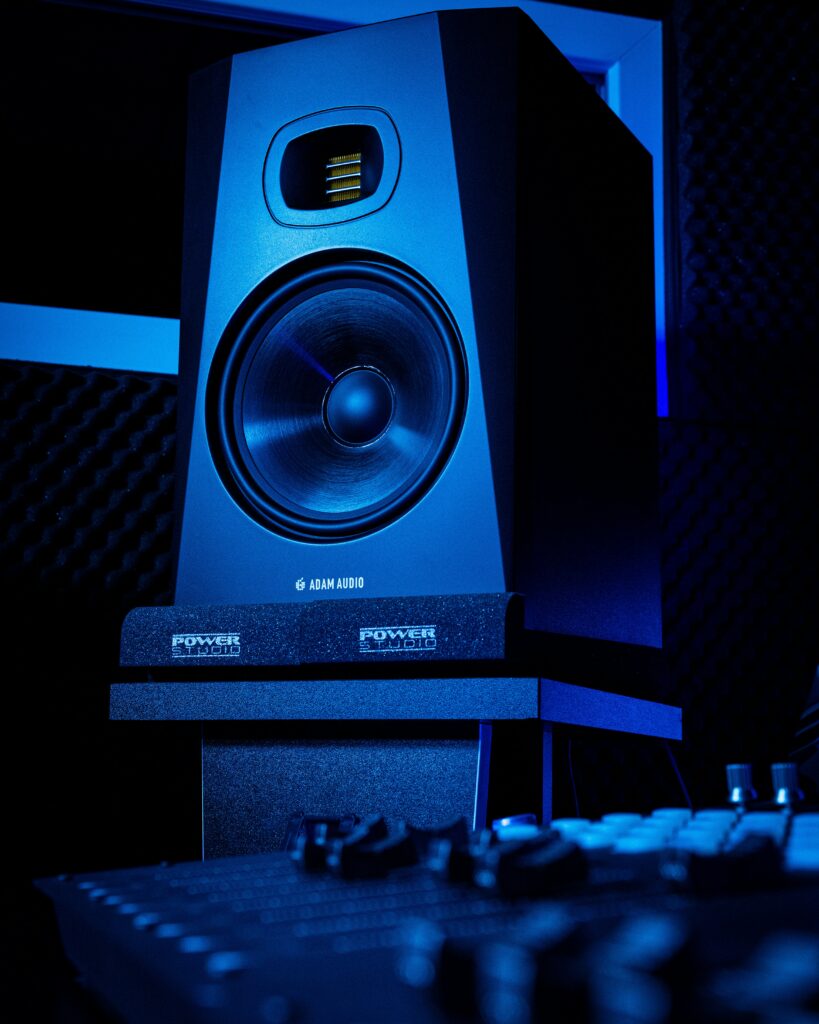
- Adam Audio T7V / A7V: Celebrated for their unique X-ART accelerated ribbon tweeters. These monitors offer incredible high-frequency detail and an ultra-wide sweet spot, making them perfect for precise vocal editing and sound design without causing ear fatigue.
- Yamaha HS7 / HS8: The absolute industry standard for translation. Featuring the famous white woofer, the HS series is famous for its brutally honest mid-range. They don’t try to make your music sound beautiful; they make you work hard for a good mix, ensuring your audio translates perfectly to any commercial playback system.
4. How to Objectively Measure Speaker Performance
When comparing studio monitors, you do not have to guess—you can evaluate objective data directly from the Specification Sheet (Spec Sheet). Here are the core engineering metrics that justify a premium price tag:
Total Harmonic Distortion (THD)
THD measures how much unwanted harmonic distortion a speaker adds to the original audio signal. If a studio monitor features an exceptionally low THD percentage, there is a clear engineering justification for a higher price. You are paying for pure acoustic transparency. Buying an overpriced speaker just because the Brand is considered prestigious, without any laboratory data or a low THD graph to back it up, is a flawed purchasing decision.
Power Handling & Thermal Endurance
True cost-effectiveness is also determined by the speaker’s Power Handling and thermal endurance. This metric defines how much continuous electrical power (in RMS Watts) you can feed into the speaker’s voice coil before triggering Power Compression, causing dynamic distortion, or physically burning out the component. A great monitor handles high transients cleanly without choking.
Efficiency and Sensitivity
Professional manufacturers always provide complete, transparent THD and sensitivity graphs. For instance, in live sound and PA Systems (Public Address), maximizing the Sensitivity rating is critical. High sensitivity means the speaker converts electrical wattage into acoustic volume as efficiently as possible, delivering massive sound pressure levels (SPL) without straining the amplifier.
The Power Compression Trap (Why 99% of Wattage is Wasted)
Here is a shocking physical reality that every audio engineer must understand: the moving-coil dynamic loudspeaker is an incredibly inefficient transducer. In fact, its efficiency rating typically hovers around a mere 1% to 3%.
This means that a staggering 97% to 99% of the electrical energy pumped from your power amplifier into the speaker is completely wasted. It does not turn into sound waves; instead, it converts directly into pure heat inside the voice coil.
This thermodynamic limitation triggers a destructive phenomenon in the studio known as Power Compression:
- The Heat Build-Up: As you turn up the volume in your DAW and push more wattage into the monitors, the copper voice coil heats up aggressively.
- The Impedance Spike: Physics dictates that as the temperature of copper rises, its electrical resistance and Impedance automatically increase.
- Ohm’s Law in Action: According to Ohm’s Law, when resistance increases, the speaker can draw less current from the amplifier.
The Damage to Your Mix
The real-world consequence of Power Compression inside your studio is brutal. As you push your monitors harder over a long session, their acoustic output stops rising linearly with the electrical power supplied.
The audio naturally begins to undergo physical compression. Your Dynamic Range gets squashed, and the balance of your low-end (the bass) changes drastically, deceiving your ears while you mix.
This is exactly why seasoned audio professionals calibrate their studio monitors to a strict, fixed listening level—typically between 79 dB SPL and 85 dB SPL. Operating within this sweet spot avoids Power Compression, preserves speaker linearity, and prevents severe ear fatigue.
Remember this golden rule: A speaker’s wattage rating does not represent its actual volume or loudness. Whether a monitor is rated at 30W or 100W, that number represents only one thing: the maximum electrical energy the voice coil can absorb before it physically burns out or suffers catastrophic thermal damage.
The Real Indicator of Loudness: Efficiency and Sensitivity
If wattage doesn’t determine volume, what does? The answer is Sensitivity.
Loudspeaker sensitivity is measured and expressed in dB SPL (Sound Pressure Level) at a distance of 1 meter when driven by 1 Watt of electrical power (standardized as 1W @ 1m).
At the end of the day, acoustics is pure physics. If a studio monitor produces a sensitivity of 90 dB SPL for 1W of electrical energy, it means its acoustic conversion efficiency is incredibly low—hovering around just 1.25%. The rest of that electricity, as we learned, turns into wasted heat in the voice coil. Therefore, if you want a system that sounds loud and operates effortlessly without straining your amplifiers, do not look for high wattage—look for high sensitivity ratings.
Multi-Way Systems vs. The Myth of the Full-Range Speaker
To achieve optimal sound reproduction, professional audio engineering requires us to divide the human hearing spectrum (which spans from 20 Hz to 20 kHz) into dedicated sub-bands.
Physics dictates that the narrower and more focused a speaker driver’s frequency range is, the higher the performance and acoustic fidelity it can deliver within that specific zone.
Consequently, any single speaker driver that attempts to reproduce the entire spectrum from 20 Hz to 20 kHz (often marketed as a “Full-Range” speaker) will always be an acoustic compromise. It simply cannot be an accurate tool for mixing.
Conversely, a speaker element engineered to reproduce only 20 Hz to 200 Hz (a Subwoofer or Woofer), or a driver dedicated exclusively to 10 kHz through 20 kHz (a Tweeter), will execute its job with immense precision and detail within its relevant band.
An advanced studio setup that combines multiple dedicated elements to seamlessly cover the entire frequency spectrum together is called a Multi-Way System (such as 2-Way, 3-Way, or 4-Way monitors). The system’s classification is determined by the number of frequency crossover points and independent drivers. By building a layout where each speaker operates strictly within its ideal frequency comfort zone, we eliminate compromises and achieve true, uncompromised audio translation across the entire spectrum.
5. Matching the Monitor to Your Application (Near-Field Reality)
An expensive speaker is useless if it is wrong for your room. You must evaluate how the monitor fits physically and acoustically into your specific workspace.
If your room setup requires a Near-Field monitoring configuration (listening at a close range, typically 3 to 5 feet), buying a massive, high-powered Main Monitor and shoving it onto your desk is a critical mistake. Instead, you should invest in a compact, precise 5-inch or 7-inch monitor.
There is no single metric that determines the “perfect” speaker. Ultimate utility is a combination of low distortion, robust power handling, and how perfectly the speaker’s physical size translates to the acoustics of your production environment.